Vittorio Bresciano
ONIRO
2024
Academic Project
Group
Collaboration with
ESA - European Space Agency

Design premise
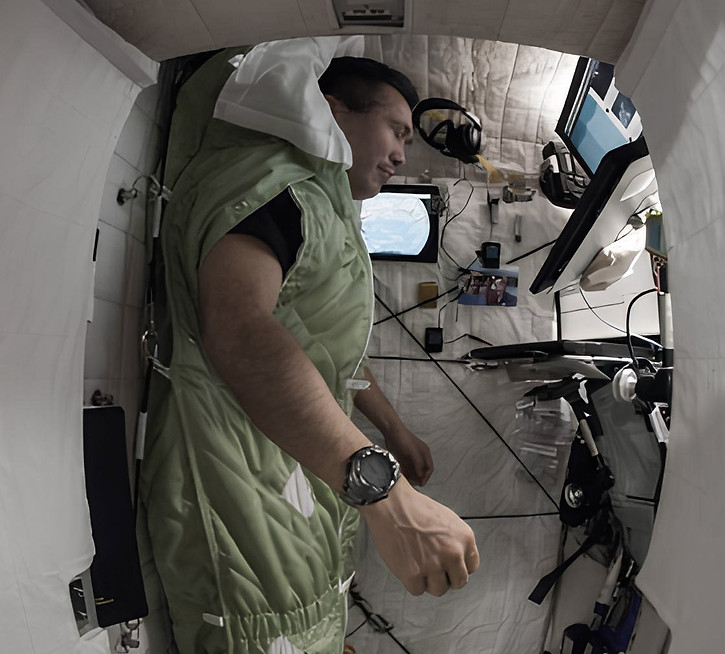
Aboard the International Space Station, insomnia is a widespread issue, negatively affecting astronauts’ performance. The main causes are the absence of a natural day-night cycle, artificial lighting, and noise: on average, they sleep just over 6 hours, and many rely on sleeping pills.
Current solutions are limited, often uncomfortable, and based on pharmacological approaches. Additionally, extremely confined spaces represent a further constraint for introducing new solutions.
INSOMNIA
DRUGS
CIRCADIAN RHYTHM
SLEEP
IN THE SPACE
Design question
How might we improve astronauts’ sleep quality, reducing reliance on pharmacological solutions, through a non-invasive system adaptable to the extremely limited spaces of the space station?
The solution

Oniro is a device designed to improve astronauts’ sleep, transforming the sleeping bag into an active and intelligent system.
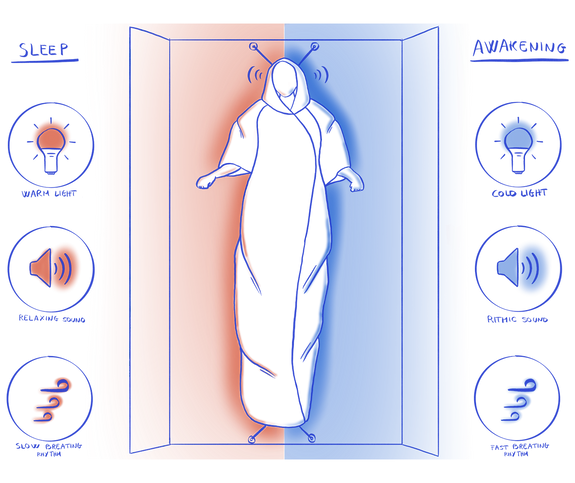
It integrates sound, light, and breathing to support falling asleep and natural awakening, regulating circadian rhythm and respiration. Designed for confined spaces, it is ergonomic and comfortable.
The goal is to provide more natural and effective rest, improving wellbeing and performance.
ACTIVE SYSTEM
WELLBEING

How it works

PLANNING
From the base station, the rhythms and operating times of the sleeping bag are programmed.
SLEEP ROUTINE
When the astronaut enters the sleeping bag, the system activates and operates completely autonomously, turning on and off at the appropriate times without the need for interaction.
Acoustic system

Breathing support

Lighting system

Lumbar and postural support

Quick-release closure system

The prototype